
World Cleanup Day
our flagship campaign with a truly impressive global impact
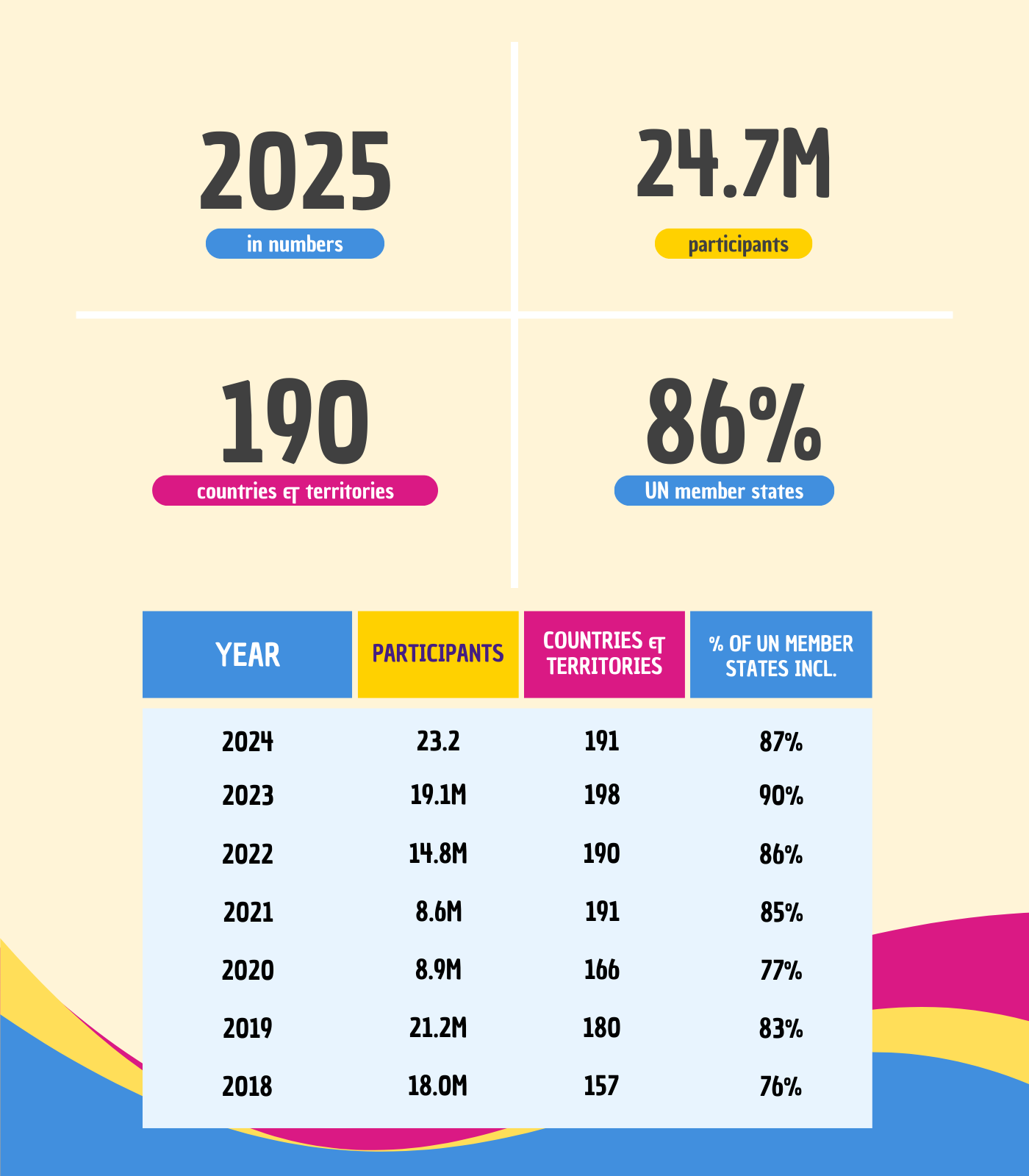
World Cleanup Day has brought together over 139 million people in 212 countries to tackle the waste crisis.
The 2025 year's World Cleanup Day took place on Friday 20 September, in its second year as an International Day on the United Nations Calendar!
Our ambitious goal is to engage 5% of each country's population in a one-day cleanup action. Such engagement will have transformative impact on societies by raising awareness about waste management, changing attitudes towards waste, and catalyzing cross -sectoral cooperation for circular economy.
We are a unifying movement that transcends borders, cultural differences, and even conflicts.
On one single day each year, volunteers and partners worldwide come together, to raise awareness of the global mismanaged waste crisis.
Since 2018, World Cleanup Day has become the biggest civic movement in human history, uniting 212 countries & territories across the world, and 139 million volunteers, equal to 1.68% of global population- all striving to create a cleaner planet.
Nearly every human on this planet has a place they call ‘home’, be it a mansion, a street, a hut or an apartment in a metropolis. We live in villages, towns, cities, regions, countries, and continents – yet humanity only has one planet that we can call ‘home’.
When 50,000 Estonians cleaned their home country in just 5 hours, the world got wind of it – the simplicity of the idea, and the ‘Let’s do it!’ attitude, took off. The rest, as they say, is history.
Anyone can pick up trash; in 2018, a 101-year old man volunteered to clean in Curaçao. In Estonia, a group of mothers carrying their babies went out to clean. In Scotland, a dogs’ association came out with the animals to help clean the environment...
But World Cleanup Day has become so much more than the simple act of picking up trash. Daycare centres, schools, companies, government officials – the old, the young, the rich, the poor, the able and less able – everyone contributed.
Because they could.
Because they wanted to be involved in making their home a better place.
Because they were given an opportunity to help.
Because they belong to a community.